ECCV 2026

NoDrift3R: Raymap-Guided Coupling for Drift-Robust Unposed Feed-Forward 3D Reconstruction

1Sungkyunkwan University 2Horizon Robotics 3Yonsei University
Corresponding authors

Abstract

Pose-Free Feed-forward 3D Gaussian Splatting (3DGS) has recently emerged as a powerful paradigm for fast scene reconstruction. However, its performance degrades significantly in long image sequences due to cumulative camera pose estimation drift, which propagates errors into geometric modeling and severely limits rendering fidelity. In this work, we revisit the long-sequence bottleneck and identify pose drift as the primary factor restricting reconstruction quality. Furthermore, while SfM-based pseudo ground-truth poses introduce sensor noise, purely rendering-based supervision often leads to optimization instability and local minima due to the entangled optimization of geometry and pose. To address the challenges, we propose a synergistic pose-free framework that explicitly couples geometry and appearance via a Raymap-Guided Coupling Module (RGC). Concretely, we anchor Gaussian centers to raymap-induced geometry and jointly optimize RGB reconstruction, raymap consistency, and camera regularization under a unified objective, yielding a bidirectional feedback loop: stronger geometry improves rendering, and appearance supervision in turn refines geometry and pose. To further stabilize learning across wide temporal ranges, we introduce a Dual-Frequency Viewpoint Scheduling strategy that combines easy-to-hard interval expansion with replay of short-interval pairs. Extensive experiments across in-domain and cross-domain datasets show consistent gains in both rendering and pose estimation, with notably improved robustness on long sequences. Ablation studies validate our central insight: explicitly designed geometry-appearance synergy is the key to scalable and drift-robust pose-free feed-forward 3D reconstruction.

Method Overview

Problem Formulation

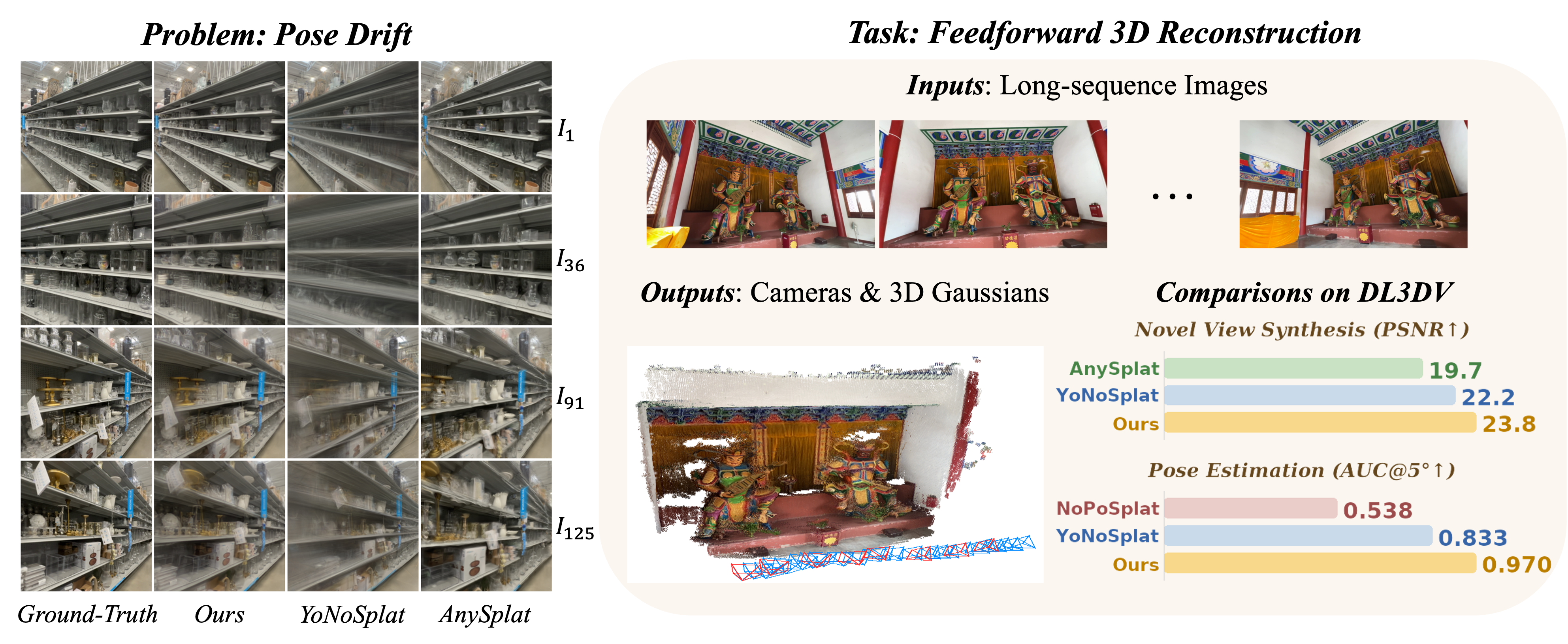
Overview of our synergistic pose-free framework for feed-forward 3D reconstruction. Our method effectively suppresses the pose drift problem, especially in long-sequence settings. Left: representative failure cases of existing methods under pose drift. Right: our pipeline and outputs (camera poses and 3D Gaussians).
Method overview figure

Our synergistic framework for "Rendering-to-Geometry Gain". Unlike previous methods that optimize geometry and pose in isolation, our approach establishes a positive feedback loop—which we term "Rendering-to-Geometry Gain"—where appearance consistency serves as a powerful geometric prior. This synergy effectively resolves parameter ambiguity and suppresses drift in extended sequences.
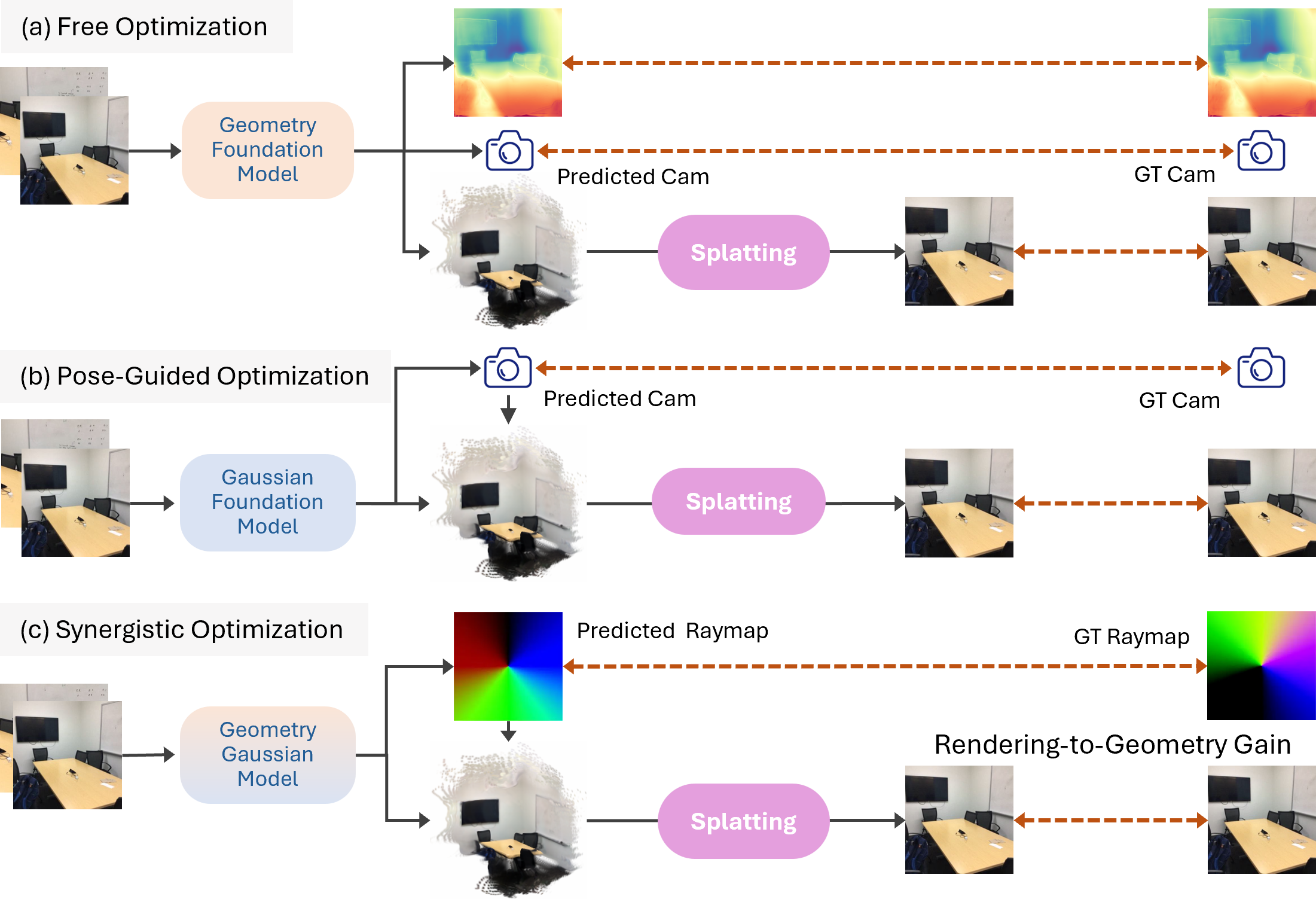
Method overview figure

Method

NoDrift3R, overview of the Synergistic Framework. (a) Ray-Based Feed-Forward GS Model. We employ a single transformer (Vallina DINOv2 model), followed by Gaussian Head, Depth Head, Ray-Map Head, and Camera Head. (b) A Raymap-Guided Coupling Module for "Rendering-to-Geometry Gain". (c) Our Replay & Overlap Scheduler leads to robust performance across arbitrary intervals.
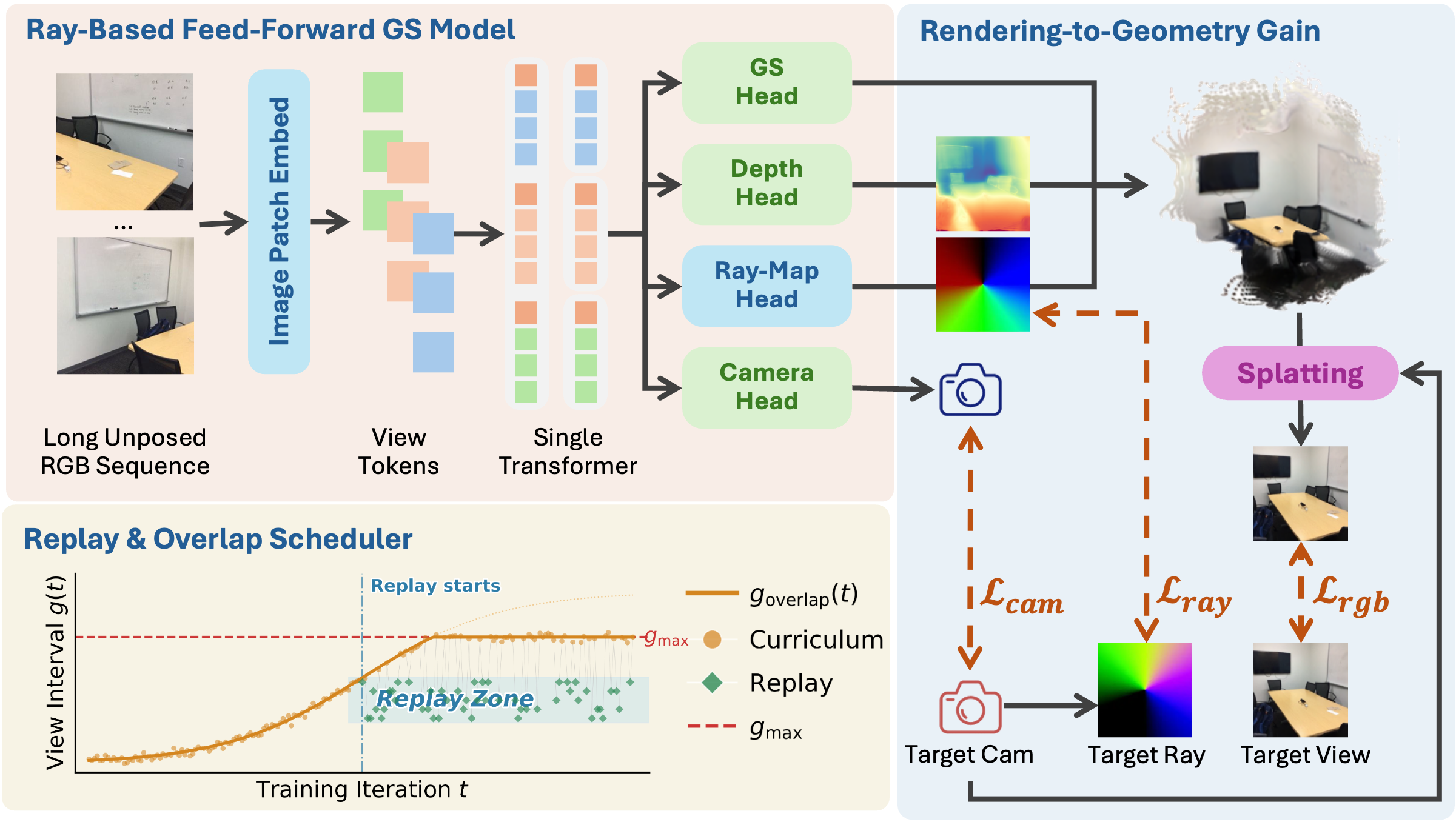
Method overview figure

Quantitative Comparison

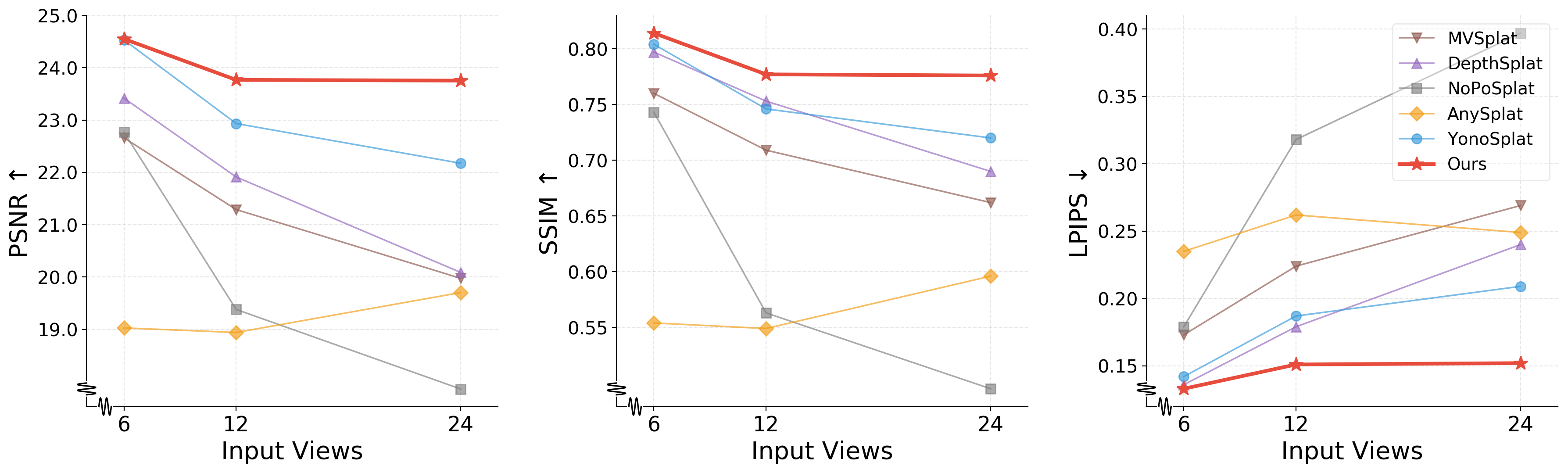
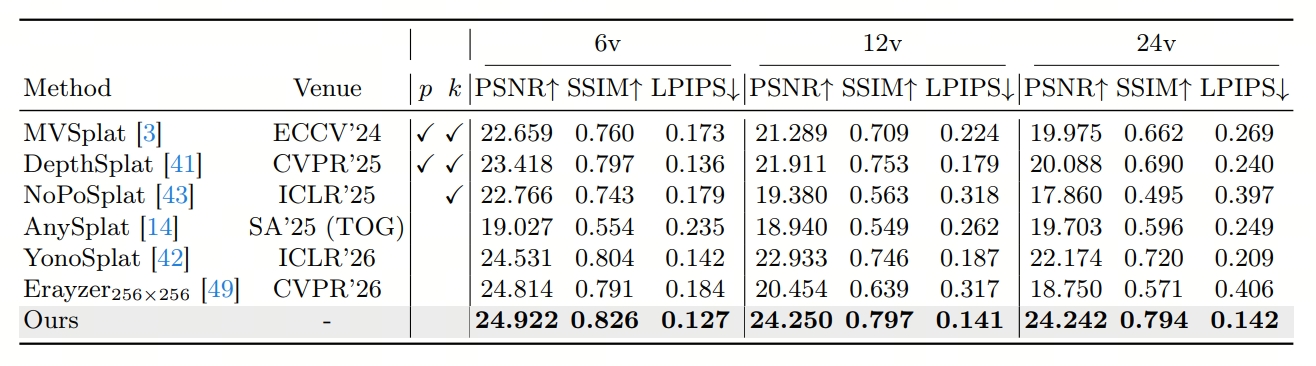
Novel view synthesis Comparison under various input settings on the DL3DV dataset. We report results with 6, 12, and 24 input views. Our model consistently achieves the best performance, where p, k denote using ground-truth poses, intrinsics.

Quantitative comparison figure

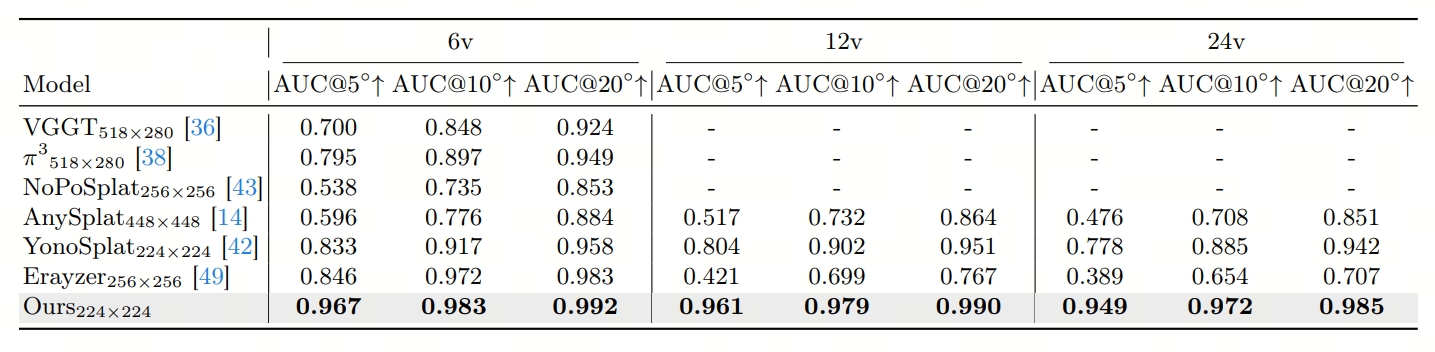
Pose estimation comparison. In the below table, our model achieves the best performance on the DL3DV dataset with an input resolution of 224x224 under various input settings.

Quantitative comparison figure

In the below table, as the number of input views increases (6→12→24), YoNoSplat degrades markedly, while our method remains stable across all metrics, demonstrating stronger robustness to pose drift in long sequences.

Quantitative comparison figure

Qualitative Results

Dataset

MipNeRF360

224x224 12 Context Views

Qualitative Comparison

Comparison between NoDrift3R and YoNoSplat on the DL3DV dataset using 24 context views with a resolution of 224×224.

Pose visualization comparison figure

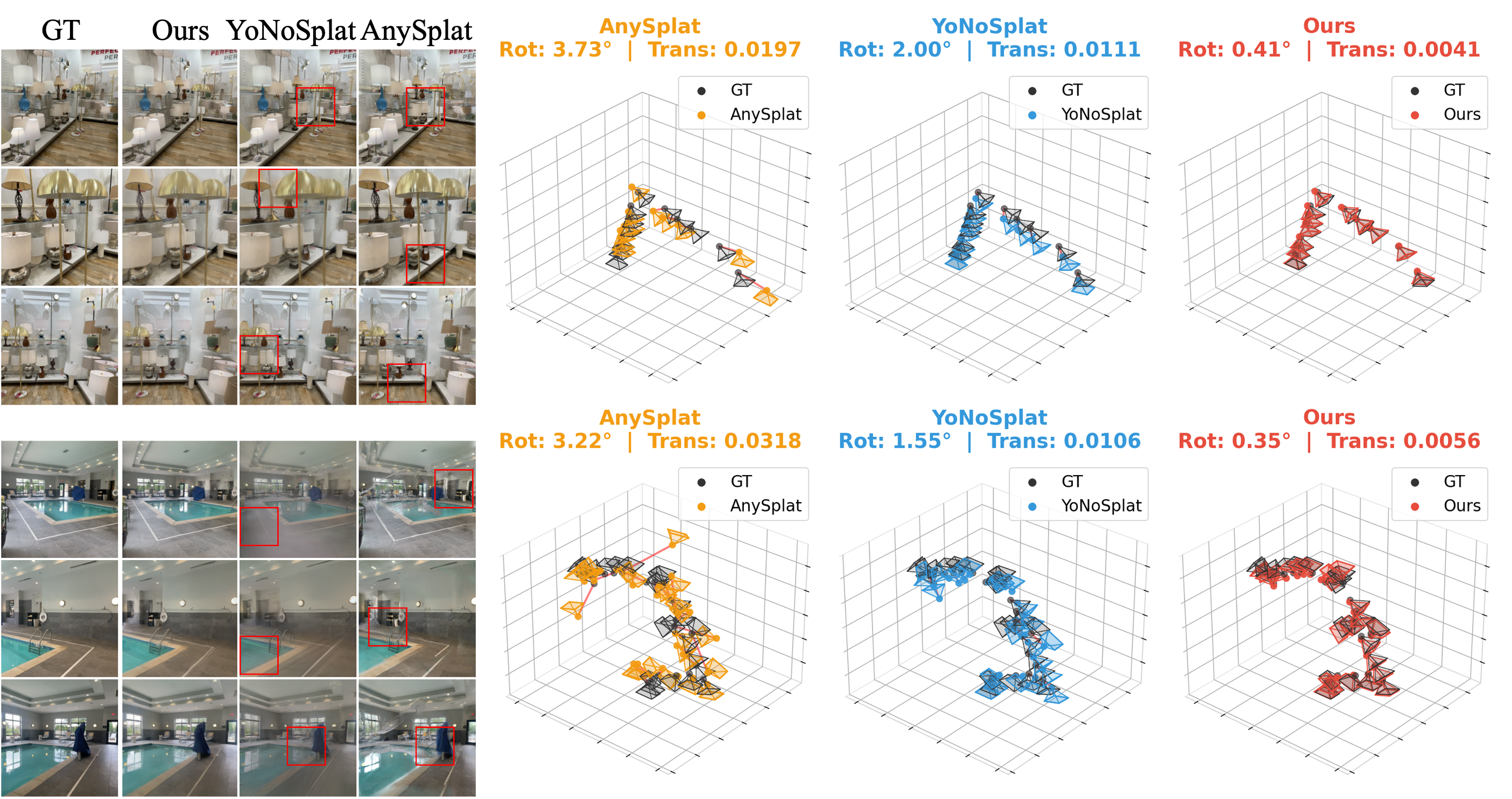
Pose visualization, compared with representative methods. Left: the rendering visualization of the target views. Right: we visualize the predicted context cameras, which shows our model can handle the pose drift problem.

BibTeX

@misc{sun2026nodrift3rraymapguidedcouplingdriftrobust,
        title={NoDrift3R: Raymap-Guided Coupling for Drift-Robust Unposed Feed-Forward 3D Reconstruction}, 
        author={Xiangyu Sun and Liu Liu and Seungkwon Yang and Jingbing Han and Seungtae Nam and Zhizhong Su and Eunbyung Park},
        year={2026},
        eprint={2607.07168},
        archivePrefix={arXiv},
        primaryClass={cs.CV},
        url={https://arxiv.org/abs/2607.07168}, 
  }